Many automation projects struggle before they even begin due to one choice: selecting the proper control system. PLCs and microcontrollers both support automation, yet they excel in very different environments. A mismatch can lead to unexpected maintenance requirements, reduced performance, and increased long-term expenses.
Industry research shows that 65% of organizations adopting automation technologies report measurable improvements in productivity and operational output. Achieving those results depends heavily on choosing a control platform aligned with system demands, environmental conditions, and scalability goals.
This comparison offers a clear understanding of the differences between PLCs and microcontrollers, enabling engineers and decision-makers to ensure reliability, optimize costs, and deliver smarter automation solutions.
What Is a Microcontroller?
A microcontroller is a compact, self-contained computing chip that controls a specific task within an electronic device. It integrates a processor, memory, and input/output interfaces on a single chip, making it ideal for embedded systems and products that require programmed, automated behavior.
Core characteristics include:
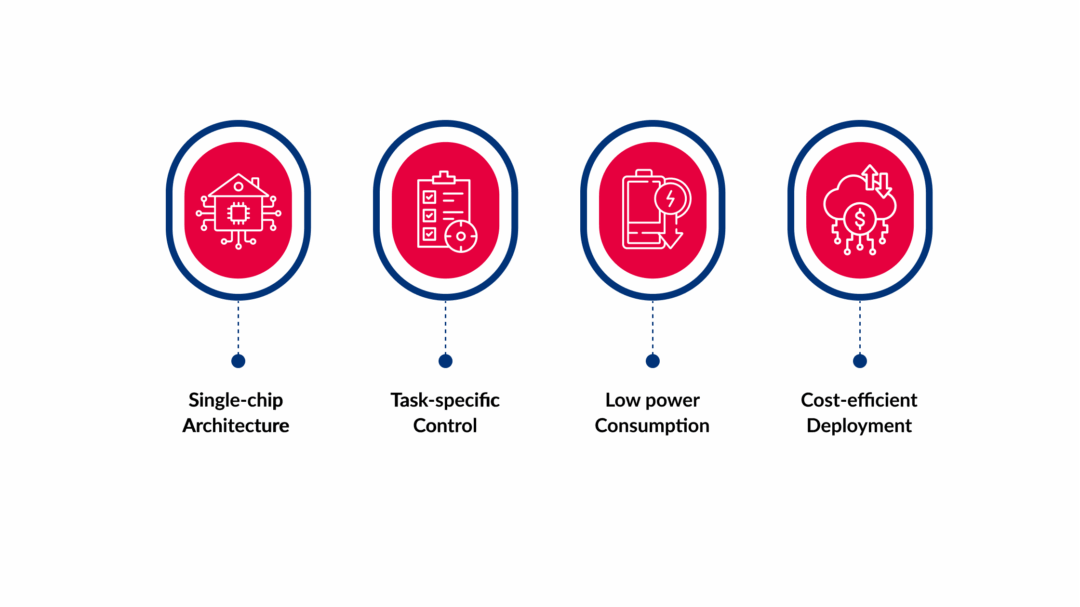
- Single-chip Architecture: Processor, memory, and I/O combined into one integrated unit.
- Task-specific Control: Optimized to handle a dedicated operation or function efficiently.
- Low power Consumption: Suitable for battery-operated and compact electronics.
- Cost-efficient Deployment: Economical choice for high-volume consumer and industrial products.
Microcontrollers deliver reliable, deterministic control within space-restricted products such as smart sensors, household electronics, wearables, and compact industrial devices.
What Is a PLC?
A Programmable Logic Controller (PLC) is an industrial-grade control system engineered to automate complex processes and ensure reliable operation in demanding environments. It utilizes a programmable processor to monitor inputs, execute logic-based instructions, and control machinery or equipment in real-time.
Major characteristics include:
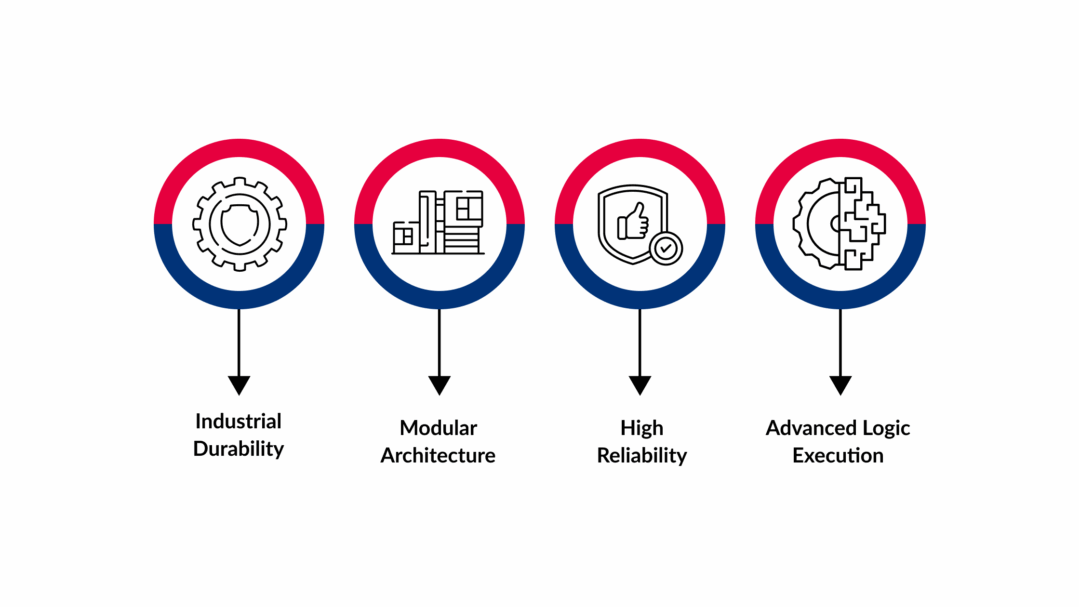
- Industrial Durability: Built to withstand heat, vibration, electrical noise, and harsh operating conditions.
- Modular Architecture: Expandable design supporting multiple I/O modules, communication interfaces, and advanced control functions.
- High Reliability: Ensures continuous operation for mission-critical processes with minimal downtime.
- Advanced Logic Execution: Capable of multitasking, real-time decision-making, and integration with SCADA or DCS systems.
PLCs are widely used across manufacturing plants, utilities, and industrial automation systems where uptime and safety are non-negotiable.
Similarities Between PLCs and Microcontrollers
PLCs and microcontrollers often stand on opposite sides of the industrial-automation decision, yet both share characteristics that make them essential in modern control systems.
Each operates as a programmable electronic device that receives signals, processes inputs, and delivers outputs based on user-defined logic.
Both also rely on firmware and programming environments to dictate behavior, allowing engineers to customize functionality for automation, measurement, or control.
They also provide advantages, including:
- Logic Execution: Both execute instructions sequentially or cyclically to control machines and processes.
- Signal Processing: Both handle digital inputs/outputs to interact with sensors, actuators, and external devices.
- Compact Integration: Both combine the processor, memory, and I/O interfaces into efficient control units.
- Energy Efficiency: Both are engineered to operate using minimal power while maintaining reliable performance.
- Automation Capabilities: Both enable automation of repetitive tasks, improving efficiency and reducing manual errors.
Still, these similarities only reinforce the importance of choosing the right controller for the right job. Applications requiring rugged design, seamless industrial networking, and scale typically call for PLCs, while cost-sensitive embedded systems often lean toward microcontrollers.
PLC vs Microcontroller: Major Differences
Selecting the right controller influences system performance, scalability, long-term maintenance, and overall cost. PLCs and microcontrollers often appear to serve similar purposes, yet their strengths differ substantially. Understanding these distinctions helps engineers and integrators choose the optimal solution for each project’s operational priorities.
| Feature | PLC | Microcontroller |
| Primary Use Case | Industrial automation and process control | Embedded control in consumer & compact devices |
| Operating Environment | Harsh and industrial | Controlled environments |
| Programming | Ladder logic, function blocks, and industrial languages | C/C++, Assembly, Python, depending on the board |
| Hardware Structure | Modular I/O expansions, replaceable components | Single chip integrating CPU, memory, and I/O |
| Reliability | Very High | Moderate |
| Scalability | Easily scalable | Limited scalability |
| Communication | Strong support for industrial networks & protocols | Basic to moderate communication features |
| Cost | Higher upfront and maintenance expenses | Much lower cost per unit |
-
Architecture & Environment
PLCs are engineered as industrial-grade hardware, built to operate continuously in demanding environments such as manufacturing floors, power plants, and large-scale automation networks. Modular construction allows easy replacement and expansion of components like I/O cards, communication modules, and power supplies, helping facilities maintain uptime even during upgrades or repairs.
Microcontrollers take a very different design approach. They integrate the processor, memory, and I/O onto a single compact chip, minimizing size and energy consumption. This architecture makes them ideal for embedded devices and consumer electronics that require precise, low-power control in a protected environment.
Performance and durability heavily depend on the overall device design since the microcontroller alone offers no protection against moisture, dust, electrical surges, or vibration.
-
Programming & Maintenance
PLCs are configured using industrial programming standards, such as Ladder Logic, Function Block Diagram (FBD), or Structured Text, languages that are closely aligned with electrical engineering workflows. These visual and structured formats enable technicians and maintenance teams to diagnose issues quickly during live operations, which supports high-availability environments where downtime must be avoided. Updates can often be performed online, allowing production lines to continue running without interruption.
Microcontrollers, on the other hand, rely on conventional coding languages such as C/C++ or MicroPython within integrated development environments (IDEs). This offers deep control over system behavior and optimization, a major advantage for custom embedded solutions.
However, maintenance often demands coding expertise, firmware updates, and physical reprogramming access. Debugging becomes more complex, especially once the controller is inside a finished device.
-
Input/Output Handling & Scalability
PLCs are created to interface with a wide range of industrial signals, including digital, analog, and specialty modules. Expansion is straightforward through modular add-ons or remote I/O networks, making PLCs well-suited for large facilities where systems must grow over time without major redesigns.
Their architecture supports long cable runs, electromagnetic interference (EMI) protection, and robust signal conditioning to ensure consistent performance in harsh plant environments.
Microcontrollers integrate a limited set of I/O directly on the chip. While sufficient for compact devices, the total number of inputs/outputs is fixed unless external components are added. Such expansion typically increases design complexity and requires careful engineering to ensure reliable sensing, communication, and power handling. Microcontrollers excel where the I/O needs are known, stable, and minimal, such as in consumer electronics or dedicated embedded systems.
-
Cost & Deployment
PLCs often require a higher upfront investment because they incorporate industrial-grade components, modular expansion options, certified safety features, and rugged enclosures ready for immediate installation in factory environments.
The deployment process is streamlined: mount the PLC, wire field devices, program using vendor software, and the system is operational with minimal custom hardware engineering. These characteristics make PLCs cost-effective in the long run for industrial operations that require reliability, uptime, and rapid maintenance.
Microcontrollers offer significantly lower component costs and can drastically reduce expenses when manufacturing at scale. However, they demand custom circuit design, PCB development, external power regulation, protective housings, and rigorous testing before they can operate safely in real-world conditions.
Deployment timelines are longer because engineering teams must tailor both the hardware and firmware to the specific application. Microcontrollers provide the most economic value in mass-produced products or compact systems where every dollar and millimeter of space matters.
-
Lifecycle, Support & Long-Term Maintainability
The lifespan of industrial equipment often spans 10–20 years or more, meaning support and upgrade paths matter as much as the initial design. PLCs typically offer extensive vendor support and standardized programming compatibility across generations.
PLCs receive long-term firmware and service support. Replacement parts remain available well beyond the initial deployment. Industrial technicians can troubleshoot quickly using visual ladder logic. Microcontroller-based systems need custom firmware updates and developer availability
Organizations evaluating the total cost of ownership often find PLCs more sustainable over long deployments.
How Each Technology Excels Across Different Industry Use Cases
Control systems succeed when they align with their environment. The choice between a PLC and a microcontroller often becomes clear once the application scenario is defined. Industrial facilities operating 24/7 with strict safety demands typically steer toward PLCs. Meanwhile, compact consumer devices and IoT hardware lean heavily on microcontrollers due to size, power, and cost constraints.
PLCs are commonly used in:
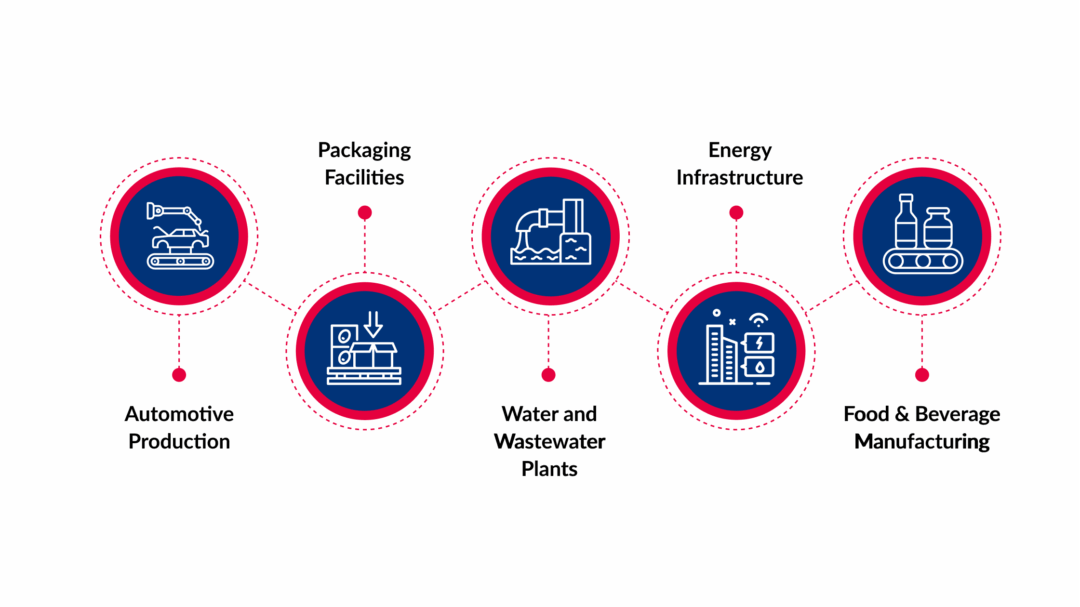
- Automotive Production: Reliable control of robots and conveyor systems
- Packaging Facilities: Coordinated high-speed sorting and labeling
- Water and Wastewater Plants: Continuous monitoring of pumps and valves
- Energy Infrastructure: Substations, grid automation, and power distribution
- Food & Beverage Manufacturing: Strict compliance with hygiene and safety requirements
Microcontrollers are preferred for:
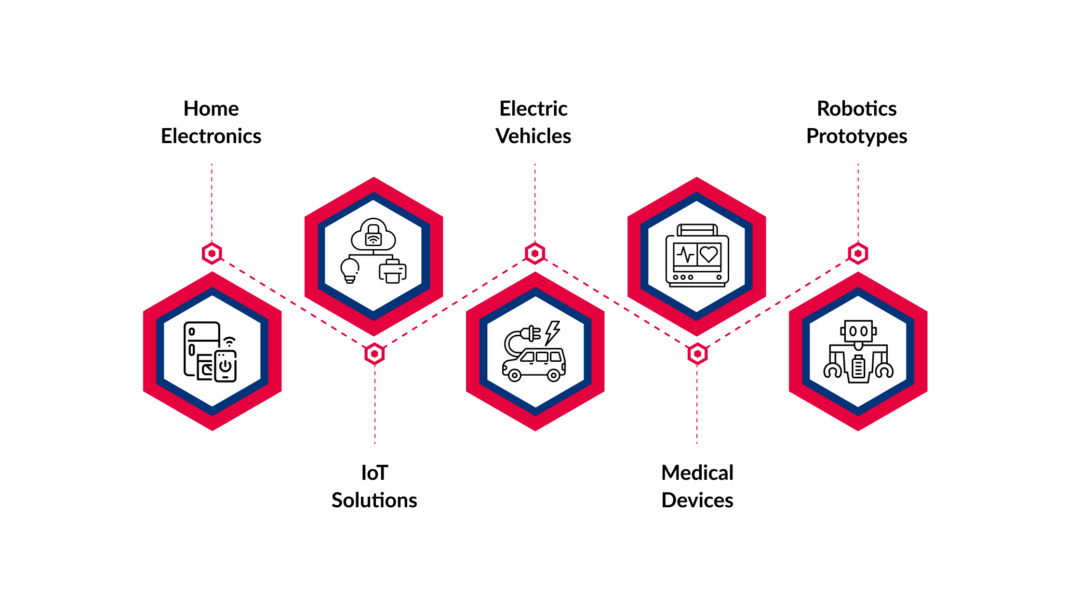
- Home Electronics: Appliances, alarms, remote controllers
- IoT Solutions: Smart thermostats, sensor nodes, and wearables
- Electric Vehicles: Battery management and charging interfaces
- Medical Devices: Portable diagnostic equipment with low-power demand
- Robotics Prototypes: Compact designs where cost matters most
A single factory may use both technologies, but each one finds its rightful place based on scale, environment, and safety requirements.
How Do You Decide Between PLCs and Microcontrollers for Industrial Automation?
PLCs and microcontrollers control machines and automate processes, but the right choice depends on where and how your system must operate. Industrial facilities demanding continuous uptime, certified safety, and field-friendly servicing remain an intense match for PLCs. They provide built-in durability, seamless integration with industrial networking, and easier long-term support for maintenance teams.
Microcontrollers excel in compact products and cost-sensitive applications where maximum design freedom is required. They enable customized hardware, high-volume manufacturing, and tight control over every watt of power consumed. This makes them ideal for commercial devices, robotics platforms, and specialized automation tools.
A simple way to decide:
- Select a PLC when reliability, compliance, and scalable installation are most important.
- Choose a microcontroller when customization, space efficiency, and low per-unit cost drive the design.
The best solution aligns with your lifecycle needs and performance expectations, striking a balance between engineering control and practical deployment considerations.
Build a Stronger, Smarter Industrial System with LS Electric America Inc.

Choosing the right automation system directly influences the performance, safety, and scalability of your industrial processes. While PLCs deliver fast, reliable control for complex industrial processes, microcontrollers are ideal for smaller, embedded applications that require compact design and cost efficiency
LS Electric America Inc. offers an extensive portfolio of automation technologies that serve every layer of industrial control. Our major solutions include:
- Programmable Logic Controllers (PLCs): Streamline machine and process automation with dependable control and efficiency.
- LV Drives: Optimize motor speed and energy use to improve operational performance.
- Servo Systems: Enable accurate, high-speed motion control for advanced machinery.
- Human Machine Interfaces (HMIs): Provide clear, real-time visualization and interaction with plant systems.
From individual devices to fully integrated process control, LS Electric drives stability, precision, and productivity across industries.
Discover how our automation technologies can simplify operations, improve energy efficiency, and enhance performance.